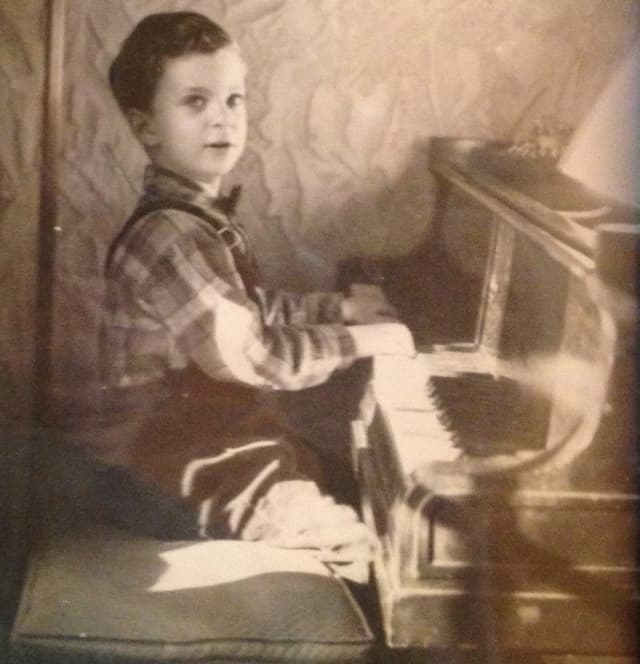
Age 4
John Simon is a multiple-threat artist — a music producer, composer, writer and performing artist in pop, rock, television, movies, and on Broadway. His name has been attached to notable projects in most of those fields. He was one of the top record producers in the United States during the late '60s and the 1970s, responsible for pulling together more than a dozen albums that are considered classics and all of which continue to sell well more than 30 years later, including The Band's “Music from Big Pink”, “The Band”, and “The Last Waltz”, “Cheap Thrills” by Big Brother & the Holding Company featuring Janis Joplin, “Bookends” by Simon & Garfunkel, and “The Child Is Father to the Man” by Blood, Sweat & Tears.
Simon was born in Norwalk, CT, in 1941, the son of a country doctor who played the violin in his spare time. He began learning the violin and the piano while still a child, and was writing songs before he was ten years old. In his teens he was leading and composing for bands in his high school and authored a pair of musicals, and later wrote music for stage productions at Princeton University. His passion for musical theater continued throughout his career — read about his original musicals. His early musical influences included both popular music and jazz, which broadened to encompass rock & roll and other musical genres.
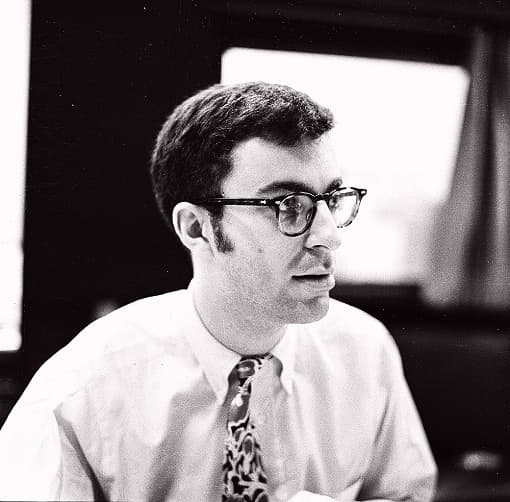
At Columbia Records
In his early twenties, he joined Columbia Records as a junior producer, and was at first assigned to assist on various projects under the aegis of Goddard Lieberson, legendary president of the company, including cast recordings and audio documentary albums — among the latter was “Point of Order”, an LP depicting the notorious hearings conducted by Senator Joseph McCarthy. Among his other early credits were “Of Course, of Course” by the Charles Lloyd Quartet, the Sunjet Serenaders' “Steelband Spectacular”, The Woodstock (Md.) Jesuit Singers' “Hymns In English For The Catholic Church” and 2 albums by Frankie Yankovic, America's Polka King. He enjoyed his first popular success in 1966 with the single “Red Rubber Ball” by the Cyrkle, which reached number two on the charts. He also produced a distinctive album featuring Marshall McLuhan, “The Medium Is the Massage”.
Simon was one of the Columbia employees present at the Monterey Pop Festival in 1967, where he met Peter Yarrow — through their mutual friend, Ed Kleban, lyricist of “A Chorus Line”. Simon and Yarrow ended up co-producing one of the more notorious projects of the era, the counterculture/music documentary and accompanying soundtrack “You Are What You Eat” (1968). His work on that project, however, was to have a profound impact on the course of Simon's career and the direction of rock music.
One of those working on the movie was Howard Alk, a former club owner from Chicago and a friend of Albert Grossman, manager of Peter, Paul & Mary, Bob Dylan and others. Alk had been an assistant to D.A. Pennebaker on the Bob Dylan documentary “Eat the Document”. He had since been hired by Dylan and was up in Woodstock in 1967 when he got involved with Yarrow and Simon. It was Alk who helped introduce Simon to The Band — Simon and The Band recorded a demo of 4 songs which eventually made their way onto their debut album and (with Albert Grossman's negotiating skills thrown into the mix) they got their recording contract with Capitol Records.
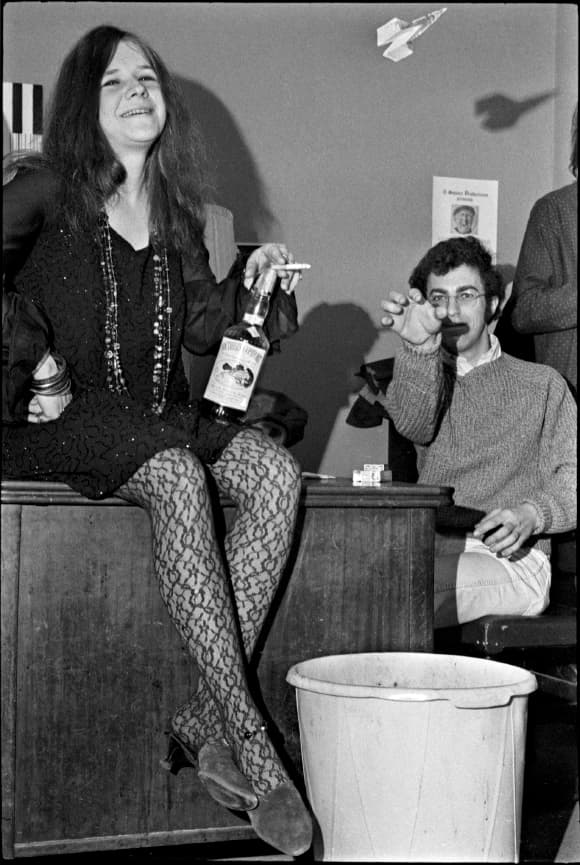
“Janis, her bottle, me, my paper airplane. Apparently not a very productive moment.” — Photo: Elliott Landy
Simon's credits in 1968 included shepherding “Bookends”, “Cheap Thrills”, “Child Is Father to the Man”, and “Songs of Leonard Cohen” through the studio for Columbia, in addition to producing Mama Cass' “Dream a Little Dream of Me” and Gordon Lightfoot's “Did She Mention My Name”. It was while Simon was working on “Child Is Father to the Man” that Blood, Sweat & Tears founder/leader Al Kooper advised him that he would do better working freelance as a producer. In the end, amid all of the possibilities that lay before him, the most important album that Simon produced that year was the Band's “Music from Big Pink”, one of the most influential and acclaimed albums of its era.
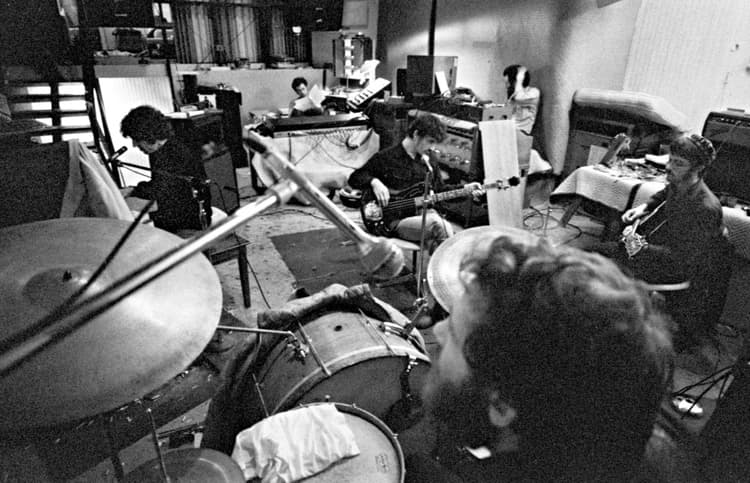
“In the studio set up in Sammy Davis Jr's pool house. Richard at the piano, me reading a manual and trying to figure out how the mixing board works.” — Photo: Elliott Landy
He entered 1969 with an already full tray, which included producing the Band's self-titled second album and the Electric Flag's self-titled 1969 album, as well as the soundtrack to the movie “Last Summer”. It was around that time that Simon found a new temptation dangled in his direction — as a recording artist in his own right. Taking heed of a suggestion made by Paul Simon and with Grossman representing him, Simon was signed to Warner Bros. as a recording artist. He cut his debut LP, titled “John Simon's Album”, in 1970, featuring members of The Band and such luminaries as Harvey Brooks, John Hall of Orleans, Rita Coolidge and Leon Russell.
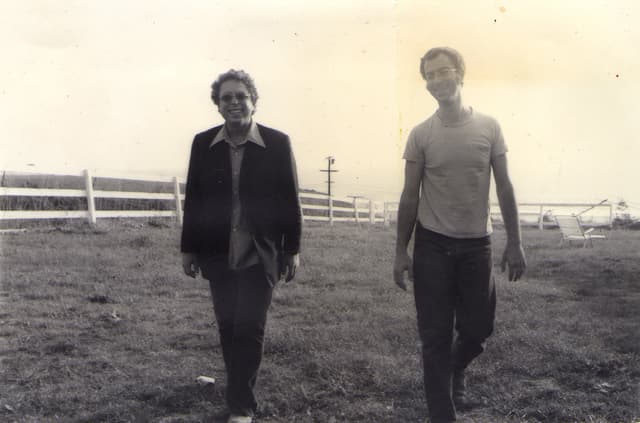
1976, Malibu — With Hirth Martinez outside The Band's studio
During the 1970s, he worked with such diverse acts as John Martyn, Gil Evans, David Sanborn, Martin Mull, John Hartford, Michael Franks, Steve Forbert, Hirth Martinez, Christine Lavin, John Sebastian, Cyrus Faryar and Al Kooper. He was the music producer of both the legendary concert and the album, “The Last Waltz”, made by his old friends, The Band. In the midst of all of that activity, he also generated a second solo album, the jazz-flavored “Journey” (1972). He also produced Japanese artists Moto Sano, Toku and Keiko Lee and composed circus music for high wire artist Phillip Petit and 2 ballet scores for choreographer Twyla Tharp, including “When We Were Very Young” on Broadway.
Simon has continued to write songs and to record on his own. He remains an active musician and producer in the 21st century. His work with The Band continues to get upgraded and reissued, as has the music he produced for Leonard Cohen, Janis Joplin, Simon & Garfunkel, Blood, Sweat & Tears et al.
The Japanese company, Pioneer/LDC Records commissioned 2 new albums of his songs. The first, “Out On The Street” was released there in 1992 where it was selected by the HMV music store chain as 1 of the 3 best records of that year (along with Eric Clapton and Peter Gabriel). He followed that album in Japan with the release of “Harmony Farm” and then “Home”. In the Spring of 2001, Dreamsville, in Japan, released his tribute to Hoagy Carmichael entitled “Hoagyland”. In 2005 he recorded an unaccompanied solo album called “No Band”.
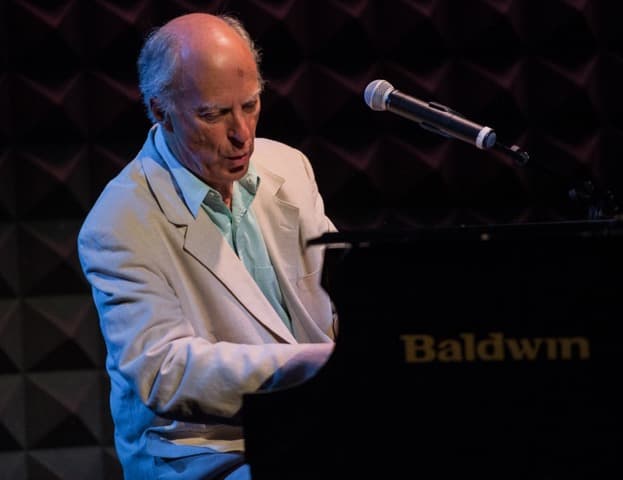
2013 — Solo show at Joe's Pub
He has performed at, among others, The Bottom Line, Fez, Joe's Pub and The Blue Note in NYC and 4 tours in Japan, including The Blue Note in Tokyo. Aside from his recording career, he has collaborated with his wife, C.C. Loveheart, in cabaret appearances and in the writing of a play, “Jackass Flats”, which had its Actors Equity, professional premiere in the summer of 2011.
His piano/bass/drums trio appeared every Thursday in Ellenville, NY for years at The Aroma Thyme Bistro — the longest-running steady gig in the Hudson Valley. He has recently played reunion tours with Taj Mahal's “tuba band” in which he originally played piano in the early '70s. He has lectured at both the Rock and Roll Hall of Fame and The Montreal Pop Festival.
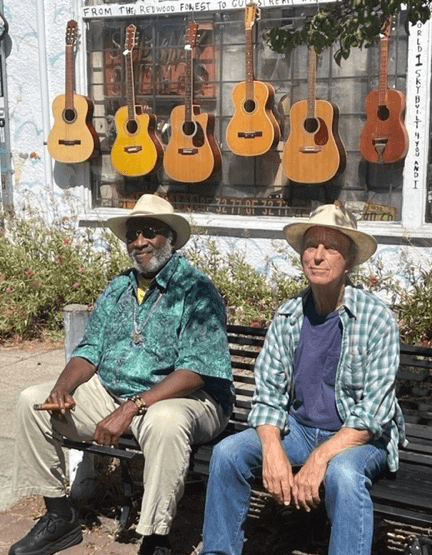
2022 — With Taj Mahal in Berkeley, discussing the “Savoy” album
“Since April of 2012, he has delivered a talk with the addition of both visual and musical aids titled ‘My Life In Rock And Roll’ or ‘Rock and Roll: Its Origins and Consequences.’”
In his semi-retirement, John remains semi-active.
Adapted and corrected from the AllMusic Biography by Bruce Eder.
Browse press clippings, reviews, and letters from throughout John's career →